Let’s be real for a second. This question… it’s a heavy one. Ask “what does the bible say about a wife,” and you’re not just asking a simple question. You’re cracking open a 66-book library written over thousands of years by people from different cultures. You’re not looking for a one-liner. You want the whole story, from the first page of Genesis to the last page of Revelation.
That’s what we’re here to do.
And for me, as a husband, this isn’t some dry, academic exercise. This is personal. This stuff shapes my marriage. It defines my role and how I see my wife. I’ve spent years digging into these verses, wrestling with them… and flat-out getting them wrong more than once.
So this article? This is the result of that long, personal study. We’re going to dive deep into what the Bible actually says, not just what grandma told you it says. We’ll hit the famous verses, the confusing ones, and the core truths that tie it all together.
More in Sexuality & Marriage Category
What Constitutes Marriage In The Bible
What Does Bible Say About Contraception
Key Takeaways
- It all starts in Genesis. The first wife is called an ezer kenegdo, a “strong helper.” This isn’t “assistant”; it’s “powerful partner.”
- That “Proverbs 31 woman”? She’s not an impossible to-do list. She’s a picture of character: wise, strong, compassionate, and, most importantly, centered on God.
- Ephesians 5 gets twisted a lot. “Submission” isn’t a one-way street. It starts with mutual submission (Eph 5:21) and comes with a much bigger command for husbands: love your wife like Christ loved the church (i.e., be willing to die for her).
- Jesus’s actions speak volumes. He treated women with revolutionary respect—teaching them, honoring them, and appearing to them first post-resurrection. That sets the ultimate context for a wife’s value.
- The big picture: A wife is not a servant. She’s a co-heir. A partner. A respected equal whose greatest strength is her character and faith.
Where Does the Story of “Wife” Even Begin?
To get this right, you have to start at page one. Not Proverbs, not the New Testament. Genesis. The origin story of marriage in Genesis 2 lays the groundwork for everything else.
God makes all this amazing stuff, calling it “good, good, good.” Then He makes Adam, and for the first time, He says something is “not good.”
“It is not good that the man should be alone; I will make him a helper fit for him” (Genesis 2:18, ESV).
Boom. That’s the birth of the “wife” concept. And the language God uses here is critical.
What Does “Helper Suitable” Actually Mean?
Our English word “helper” sounds weak, doesn’t it? Like an assistant. A sidekick. Someone who just fetches the coffee.
That is not what the Hebrew word ezer means. Not even close.
Ezer is a powerhouse word. It shows up 21 times in the Old Testament. And guess who it’s used to describe most of the time?
God.
That’s right. The same word used for Eve is used for God Himself, as the ezer of Israel. Their rescuer. Their strength. Psalm 33:20 says, “Our soul waits for the LORD; he is our help (ezer) and our shield.”
This is not the word for an intern. This is the word for a vital, strong, necessary partner. A rescuer. The other part of the phrase, kenegdo, means “alongside him” or “corresponding to him.” She was his equal. His perfect match. The one who made him complete.
So, right from the start, the design wasn’t “boss and employee.”
It was “partnership.”
So, Was Eve Created as an Afterthought?
No way. Adam’s creation was literally incomplete without her. He was alone. That was the “not good” part. Eve was the solution.
God made her from Adam’s side—a powerful image of closeness and unity. Adam’s reaction says it all: “This at last is bone of my bones and flesh of my flesh” (Genesis 2:23). He was waiting for her.
That’s the foundation. Before sin wrecked everything (the “Fall”), their relationship was a perfect, equal partnership. No ruling. No serving. Just two people ruling the earth together as “one flesh.”
This is the ideal. We have to keep this in mind as we read everything else.
The Proverbs 31 Wife: Is This an Impossible Standard?
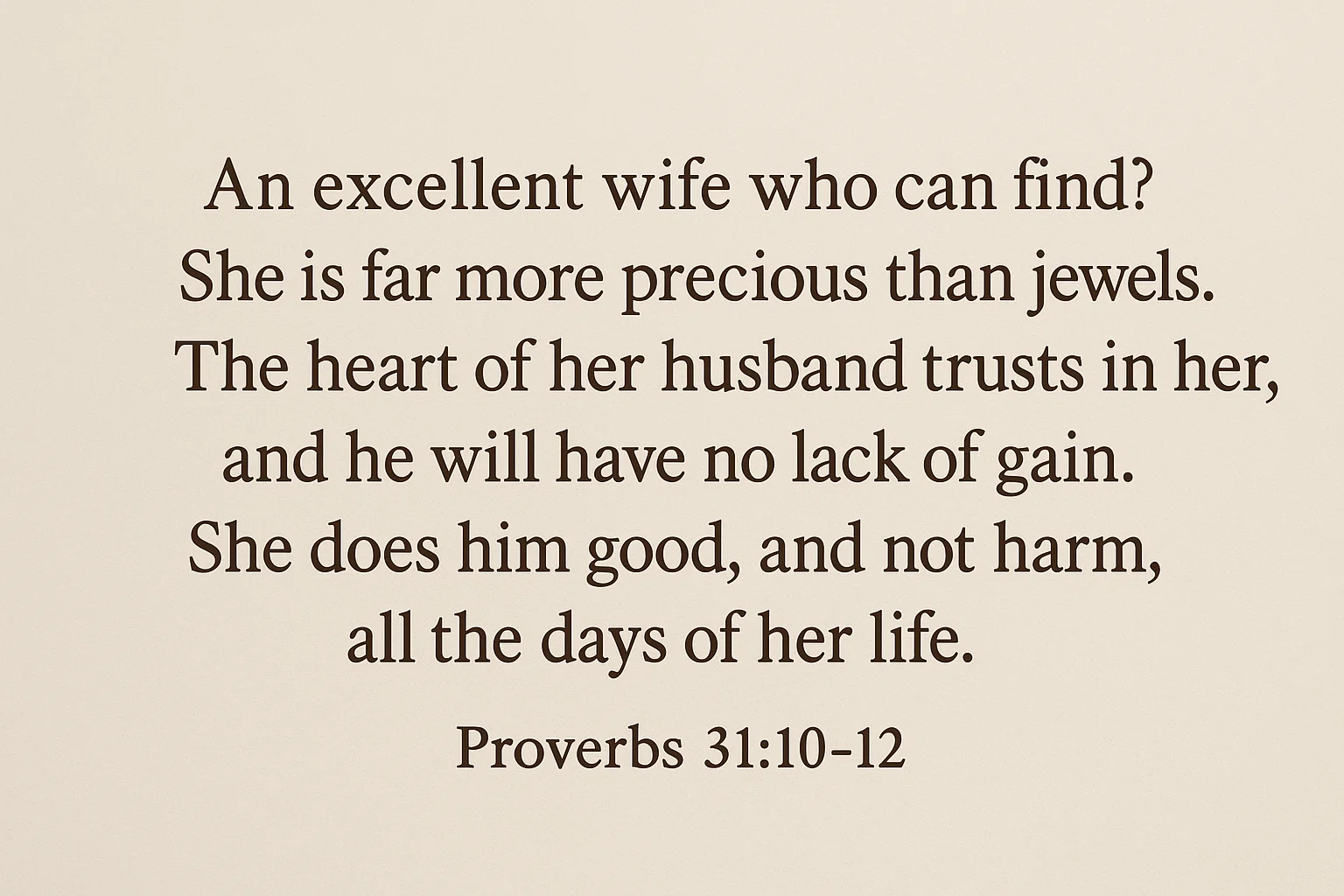
Ah, Proverbs 31. If you’ve spent any time in church, you’ve heard about this woman. She’s the epic poem, the “Virtuous Wife” checklist that has made women (and men!) feel inadequate for centuries.
My wife and I have read this passage and just laughed. “She gets up before dawn? She inspects a field and buys it? She runs a textile business out of her house? When does she sleep?”
It’s so easy to read this as a divine job description that no real woman could ever live up to. But is that the point?
What Is This Passage Really Praising?
If you read Proverbs 31 like a literal checklist, you miss the whole point. This passage is a poem. It’s an acrostic, where each verse starts with the next letter of the Hebrew alphabet. It’s a work of art, designed to praise character, not to hand out a to-do list.
And what’s her character like? She’s diligent and strong (“She dresses herself with strength”). She’s a sharp businesswoman (“She considers a field and buys it”). She’s incredibly compassionate (“She opens her hand to the poor”). She is wise (“She opens her mouth with wisdom”).
This is not a picture of a meek, silent woman hiding in the shadows. This is a dynamic, capable, and powerful partner.
So, Is Her Value Only in Her Work?
This is the most important question. After 20-some verses listing her accomplishments, the poem hits us with the punchline. It’s the secret to her entire life.
“Charm is deceptive, and beauty is fleeting; but a woman who fears the LORD is to be praised.” (v. 30).
There it is.
Her value isn’t in her productivity. It’s not in her side hustles or how clean her floors are. Her ultimate value—and the source of all her other strengths—is her relationship with God. Her “fear of the LORD” isn’t about being scared of Him. It’s about a deep, reverent awe, a life built with Him at the very center.
The Proverbs 31 woman isn’t an impossible standard to achieve. She’s a model of character to aspire to. She’s a picture of a wife so grounded in God that she is free to be strong, wise, and capable in every part of her life.
Why Is Ephesians 5 So Controversial?
Now we land in the New Testament. And we have to talk about the elephant in the room: Ephesians 5:22.
“Wives, submit to your own husbands, as to the Lord.”
Oof. No other verse, in my opinion, has caused more confusion, pain, or division. It’s been twisted to justify abuse, control, and a view of women as second-class citizens.
But you cannot understand this verse by ripping it out of its context. That’s like taking one ingredient from a complex recipe and wondering why it tastes awful.
The real context starts one verse earlier.
Verse 21 says: “…submitting to one another out of reverence for Christ.”
This is the foundation for the whole section. Paul isn’t just talking to wives. He’s talking to everyone. The baseline for all Christian relationships is mutual submission. It’s a call for all of us to be humble and put others first.
The command to wives is a specific application of this big, mutual idea.
What Does “Submit” Mean in This Context?
The Greek word, hypotassō, was a military term. It meant “to arrange under.” It’s about order and roles, not about value or worth. A captain and a general are both 100% soldiers, equal in value, but they have different responsibilities to make the mission succeed.
This submission is not a command to be a silent doormat. It’s not a demand to obey sinful or foolish orders. It is a voluntary, loving deference to a husband’s leadership as part of a team. It’s a wife choosing to trust and support her husband’s role.
And let’s be clear: her husband is commanded to do something even harder.
But What About the Husband’s Part?
This is the part that gets conveniently ignored all the time. The instruction to husbands is twice as long and infinitely more difficult.
“Husbands, love your wives, as Christ loved the church and gave himself up for her…” (v. 25).
How did Christ love the church? He taught it. He protected it. He prayed for it. And then He was brutally tortured and died for it.
The command for a wife is to respect and affirm her husband’s leadership. The command for a husband is to be willing to be executed for his wife.
I remember the first time that really hit me. As a man, it’s easy to laser-focus on verse 22. But my command wasn’t to “be the boss” or “get respect.” My command, from God, was to be willing to lay down my life for her. Not just my physical life, but my ego, my selfishness, my preferences, and my “right” to be right.
That’s a much harder job.
A wife is called to submit to a man who is called to love her so sacrificially that he would die for her. In a marriage where a husband is actually doing that, a wife’s loving and respectful support is a secure and natural response.
This passage isn’t about a corporate ladder. It’s a beautiful, living picture of the Gospel. The marriage, when it works, is a daily illustration of Christ’s sacrificial love for us (the Church) and our loving, trusting response back to Him.
What Else Does the New Testament Say?
Ephesians 5 is the big one, but it’s not the only word on the topic. The Apostle Peter, a married man himself, throws in his perspective.
Did Peter Have a Different Take on Marriage?
Peter’s advice in 1 Peter 3 fits perfectly with Paul’s. He also speaks to wives, but he focuses on a very specific, real-world scenario: a believing wife married to an unbelieving husband.
He tells these women their husbands can “be won without a word by the conduct of their wives” (1 Peter 3:1). How? Not by nagging. Not by preaching at him or leaving tracts in his shoes. But by her “respectful and pure conduct.”
He then zeroes in on what true beauty is.
What Is This “Inner Beauty” Peter Talks About?
Peter paints a contrast between two kinds of beauty. He says, “Do not let your adorning be external—the braiding of hair and the putting on of gold jewelry, or the clothing you wear…” (v. 3).
He wasn’t banning jewelry or a nice outfit. He was speaking into a culture where, just like today, women were crushed by the pressure to find their entire value in how they looked.
Peter pointed to a better, more permanent way. He says, “…but let your adorning be the hidden person of the heart with the imperishable beauty of a gentle and quiet spirit, which in God’s sight is very precious” (v. 4).
A “gentle and quiet spirit” doesn’t mean a “silent or mousy personality.” Not at all. It means a spirit that isn’t full of anxiety, agitation, or drama. It’s an inner strength, a deep-down peace and confidence that comes from God, not from what other people think.
This inner character, Peter says, is “imperishable.” It doesn’t fade. It doesn’t get wrinkles. And it’s what God Himself finds “very precious.”
What Does He Mean “Weaker Partner”?
Peter also has a sharp command for husbands. “Likewise, husbands, live with your wives in an understanding way, showing honor to the woman as the weaker vessel, since they are heirs with you of the gracious gift of life, so that your prayers may not be hindered” (v. 7).
That phrase “weaker vessel” (or “weaker partner”) has caused a lot of trouble. Does it mean women are morally, intellectually, or spiritually weaker? No. Absolutely not. Given the culture, it almost certainly refers to a general difference in physical strength or a more vulnerable position in society.
But look at the reason he gives for showing her honor. It’s because “they are heirs with you of the gracious gift of life.”
This is a radical statement of equality. In God’s kingdom, there’s no “junior partner.” They are co-heirs. They get the same grace, the same gift, the same inheritance. Peter then drops a bomb on the husbands: if you don’t honor your wife as your spiritual equal, your prayer life will be blocked. God won’t listen.
That’s how seriously God takes the honor due to a wife.
What About Paul’s Letters to Timothy and Titus?
Paul gives some more practical advice to his ministry apprentices, Timothy and Titus, who were planting new churches. In Titus 2, he outlines a mentorship model, telling the “older women” to “train the young women to love their husbands and children.”
This training included teaching them to be “self-controlled and pure,” to be “busy at home” (or “working at home”), to be “kind,” and to be “subject to their own husbands.”
And why? Paul gives a very practical reason: “…so that the word of God may not be reviled” (Titus 2:5).
This is a key detail. The early church was a tiny, weird, counter-cultural movement inside the massive Roman Empire. The public perception of women in the Roman world was complex, but the general expectation was one of domestic order.
Paul’s concern was practical. He was protecting the church’s reputation. If Christian women were seen as chaotic, rebellious, or abandoning their families, it would bring shame on the Gospel and push people away. This wasn’t about limiting a woman’s potential (Proverbs 31 shows a wife with a thriving business), but about using her freedom in Christ with wisdom and love.
Navigating the “Difficult” Passages
No “complete study” would be honest if it dodged the hardest verses. The most difficult is 1 Corinthians 14:34-35, where Paul writes, “the women should keep silent in the churches. For they are not permitted to speak, but should be in submission, as the Law also says.”
Why Does Paul Say Women Should Be Silent in Church?
This verse seems like a total contradiction. How can Paul demand total silence here, but in the exact same letter (1 Corinthians 11) give detailed instructions for how women should pray and prophesy in church? If they were prophesying, they clearly weren’t silent.
Context changes everything.
The Corinthian church was a chaotic mess. Their services were a free-for-all. People were shouting in tongues all at once, “prophesying” over each other, and it was just disruptive. Paul’s whole point in this chapter (1 Cor 14) is a plea for order.
Many scholars are convinced Paul was not issuing a universal, timeless ban on all women speaking for all time. He was fixing a specific, local problem. The most likely scenario is that he was telling wives to stop disruptively shouting questions to their husbands during the service (“If there is anything they desire to learn, let them ask their husbands at home” v. 35). In that culture, men and women often sat on different sides, and this would have been incredibly disruptive.
This verse is about order in a chaotic worship service, not about a woman’s value or right to contribute. The rest of the New Testament is clear that women like Priscilla, Junia, and Phoebe were vital leaders and co-workers with Paul.
What Did Jesus Say About Wives?
We’ve saved the most important person for last. We’ve looked at the Law (Genesis), the Poetry (Proverbs), and the Letters (Paul and Peter). But what about the Gospels? What did Jesus, the man at the center of it all, say?
Did Jesus Ever Talk About a Wife’s Role?
It’s fascinating. Jesus never gives a direct command like “Wives, do this…” or “Husbands, do that…” His silence on this is, in itself, telling. He didn’t come to hand out a new household rulebook.
He came to change hearts. And the way he treated women was his loudest sermon.
How Did Jesus Treat Women?
In a word: revolutionary.
In a culture that often treated women like property, Jesus treated them with profound, shocking dignity.
- He spoke openly to the Samaritan woman at the well (John 4), which shattered multiple social and racial taboos at once.
- He allowed a “sinful” woman to anoint his feet with her tears and hair (Luke 7), and He defended her against his self-righteous male host.
- He praised the faith of a desperate Canaanite woman (Matthew 15).
- He taught deep theology to Mary of Bethany, who “sat at the Lord’s feet listening to what he said” (Luke 10)—a posture that was reserved only for male disciples.
- And, in the most stunning move of all, who did He appear to first after His resurrection? Not Peter. Not John. He appeared to Mary Magdalene and the other women. He made women the first preachers of the Gospel.
Jesus consistently affirmed women, valued them, and elevated them to a status of spiritual equality that was simply unheard of. His actions speak far louder than any list of rules.
What Did Jesus Teach About Marriage Itself?
When Jesus did talk about marriage, He blew past the cultural rules and went right back to the original design from Genesis.
When the Pharisees tried to trap him on the topic of divorce, He said, “Have you not read that he who created them from the beginning made them male and female, and said, ‘Therefore a man shall leave his father and his mother and hold fast to his wife, and the two shall become one flesh’? So they are no longer two but one flesh. What therefore God has joined together, let not man separate” (Matthew 19:4-6).
Jesus’s view of marriage was this sacred, permanent, “one-flesh” union. This high view of the covenant is the ultimate protection for a wife. He wasn’t giving rules for the wife; He was re-establishing the high, holy, and protected ground on which the marriage itself stands.
So, What’s the “Big Picture” of a Biblical Wife?
After this long journey, what have we found? When we ask “what does the bible say about a wife,” we find it doesn’t say one simple thing. It paints a rich, complex, and beautiful portrait.
A biblical wife is not a doormat, a servant, or a lesser being. A biblical wife is:
- An essential partner: A strong ezer created to be a vital, corresponding partner (Genesis 2).
- A capable individual: A diligent, wise, strong, and compassionate person whose value is in her godly character (Proverbs 31).
- A respected co-heir: A spiritually equal partner, worthy of honor and understanding (1 Peter 3).
- A loving teammate: A partner in a covenant of mutual, Gospel-centered submission and love (Ephesians 5).
- A person of dignity: An individual valued, seen, and honored by Jesus Christ Himself (The Gospels).
As a Husband, What’s My Final Takeaway?
Honestly, studying this has profoundly changed my perspective. For years, I think I was quietly, and wrongly, focused on what the Bible asked of my wife. Is she living up to Proverbs 31? Is she respecting me like in Ephesians 5?
But the more I read, the more I realize the crushing weight of scripture lands squarely on me.
My job isn’t to be a “boss.” My job is to be like Christ. My focus shouldn’t be on her submission; it should be on my own sacrifice. Am I loving my wife so selflessly that she feels completely secure? Am I honoring her as a co-heir? Am I creating an environment of love and grace where she is free to be the strong, wise, and capable woman God created her to be?
The Bible’s view of a wife is incredibly high. She is God’s powerful solution to the world’s first problem. She is a co-heir of the gift of life. And in the mystery of marriage, she is the cherished partner who, together with her husband, gets to show the world a living, breathing picture of the Gospel.
FAQ – What Does The Bible Say About A Wife
What does Genesis say about the origin of the wife in the Bible?
Genesis describes the wife as an ‘ezer kenegdo,’ a strong helper and perfect partner created alongside man to form a complete and equal partnership.
How should the Proverbs 31 woman be understood?
The Proverbs 31 woman is a character portrayal highlighting qualities like wisdom, strength, compassion, and character centered on God, rather than an impossible to-do list.
What is the true meaning of submission in Ephesians 5?
Submission in Ephesians 5 starts with mutual submission among all believers; it means supporting and respecting each other, with wives submitting voluntarily to their husbands’ loving leadership, which echoes Christ’s sacrificial love.
How did Jesus treat women, and what does it say about wives?
Jesus treated women with profound dignity and respect, elevating their spiritual status and valuing them equally, which sets a foundational example of respect and honor in marriage.
What is the overarching biblical view of a wife?
A biblical wife is an essential partner, capable individual, respected co-heir, loving teammate, and person of dignity, created to reflect God’s power, grace, and the Gospel in her role.