It’s that question, isn’t it? The one you type into Google when you’re alone and no one’s looking. It just pops into your head. And it feels loaded. Loaded with confusion, shame, and, for a whole lot of people, some massive debates in church.Asking “What does the bible say about anal sex?” isn’t a small question. It’s huge. It’s personal. It pulls in theology, really difficult translations, ancient history, and the very core of who we are.
So, let’s get one thing straight right away. The Bible—this ancient library of books written over thousands of years—never uses the words “anal sex.”
Not once.
And that silence… that lack of a clear “Don’t do this”… that’s exactly why this is all so complicated.
It means we’re left to interpret. We have to dig into passages about sex in general, or “unnatural” acts, or the point of sex, or same-sex relationships. We’re trying to piece it all together.
That’s the goal here. But this isn’t about me giving you a simple “yes” or “no.” It’s about giving you the tools to understand the whole debate and find your own way.
More in Sexuality & Marriage Category
What Does The Bible Say About A Wife
Is Premarital Sex A Sin In The Bible
Key Takeaways
- The Bible never says “anal sex.” Period. So, any stance is an interpretation of other verses about sex.
- The Old Testament is a big battleground. Verses from Sodom (Genesis 19) and Leviticus (18:22) are central, and people really disagree on what they mean.
- The New Testament is just as debated. Romans 1 and 1 Corinthians 6 are key, but it all gets stuck on translating tricky Greek words like arsenokoitai.
- Your final answer probably depends on what you think sex is for. Is it just for making babies? Is it about connection? Or both?
- The Bible’s silence on sex within marriage leads many to think it’s a private decision for a couple to make themselves.
- Different churches have wildly different answers. It ranges from “absolutely not, it’s a sin” to “it’s fine if it’s loving and consensual.”
- You have to look at the ancient history and culture. Without that context, you’re missing the point. It changes everything.
Before We Dive In, Why Is This So Complicated?
It should be simple, right? Open the book. Find the verse. Get the answer. Done.
But it’s just not that easy. Not with this.
The complexity is the story.
Isn’t the Bible Just… Clear?
A lot of us were taught the Bible is a simple rulebook.
It’s not. It’s a library.
You’ve got poetry, history, personal mail, and strange visions. All written at different times, to different people, for different reasons. Plus, we’re all reading translations from ancient languages.
One Greek word might have five different meanings. The translator has to pick one. And their choice, which is always colored by their own beliefs, can change everything.
Throw in that massive gap between their world and ours, and you’ve got a recipe for confusion. We’re trying to make ancient texts fit our modern questions. It’s a messy process.
And What Does “Biblical” Really Mean Here?
So when someone demands the “biblical” view, what do they even mean? Which one?
Do they mean a view where every word is a literal, timeless rule? Or a view that looks for the big themes, like love and justice, and starts from there?
Different Christian traditions give different answers. A Catholic will lean on centuries of church tradition and “natural law.” An Evangelical will point to the text itself. A Progressive Christian will often re-read the text through the lens of Jesus’s command to love.
There’s no single, neat “biblical” view. There just isn’t.
A Personal Note: Why I’m Writing This
Look, I need to be real for a second. As a guy who grew up in church, I remember how nobody talked about sex. It was the forbidden topic. You couldn’t ask a question without getting “that look.”
I watched my friends, gay and straight, twist themselves in knots over these exact questions. In total silence. They were terrified of what they’d find.
That silence was toxic. It’s a space where shame grows and grace can’t get in. I’m writing this because I’ve learned that faith suffocates in the dark. Honest questions need honest air.
Does the Old Testament Mention Anal Sex Directly?
So, again, the direct answer is “no.” But a few key passages always get dragged into the conversation. People see them as being about acts that would include anal sex, especially between men.
What’s the Real Story of Sodom and Gomorrah (Genesis 19)?
This is the big one. The story everyone links to homosexuality. The Sunday School version is that God torched Sodom because of homosexual sin.
Specifically, that scene where the men of the city demand to “know” (the Hebrew word yada, a euphemism for sex) the angelic visitors.
In this reading, the attempted gang rape is the final straw. God’s judgment, therefore, is on that specific act.
But… there’s a very strong counter-argument. And it comes from the Bible itself.
Check out Ezekiel 16:49. It says Sodom’s guilt was “pride, excess of food, and prosperous ease, but did not aid the poor and needy.”
This reading says the sin was arrogance and sickening apathy. It was about violent inhospitality—a huge crime in the ancient world. The attempted rape, then, wasn’t the main sin. It was the horrifying symptom of a city that was totally morally rotten.
What About the Levitical “Holiness Codes”?
This is where the text gets a lot more specific. Leviticus 18:22: “You shall not lie with a male as with a woman; it is an abomination.” Leviticus 20:13 repeats this and adds the death penalty.
For many, that’s it. Case closed. Direct. Clear.
But again, context is king. What does “abomination” (to’evah in Hebrew) even mean? It sounds terrifying. But the Bible uses it for a lot of things we don’t consider “immoral” today.
It’s often about ritual impurity. Or, even more often, it’s about the idolatrous, pagan practices of the cultures around Israel, like the Canaanites.
Many scholars believe these laws were about rejecting pagan temple sex and fertility cults. It was a way of saying, “We are God’s people. We are different. We don’t do what they do.”
Are These Old Testament Laws Binding on Christians Today?
So this is the next big question, right?
Christians don’t follow all of Leviticus. We eat pork. We eat shellfish. We wear poly-cotton blends.
The early church had a huge meeting about this (in Acts 15). They decided non-Jewish Christians did not have to follow the whole Jewish law.
This leaves a huge question. Why is this one law a timeless moral command, while the ones right next to it about fabric and food are just… cultural?
Some say it’s because the New Testament repeats it (more on that in a sec). Others say this law was also cultural and just doesn’t apply to us anymore.
What Does the New Testament Say?
The whole conversation shifts in the New Testament. We’re not talking about national laws for Israel anymore. We’re reading personal letters from Paul to new, messy churches trying to survive in the wild Greco-Roman world.
Is Romans 1:26-27 the Clearest Passage?
This is the big one. Romans 1:26-27. It’s the most important NT passage in this debate. Paul writes:
“For this reason God gave them up to dishonorable passions. For their women exchanged natural relations for those contrary to nature; and the men likewise gave up natural relations with women and were consumed with passion for one another, men committing shameless acts with men and receiving in themselves the due penalty for their error.”
At first glance, this looks like a slam-dunk condemnation. Paul uses that key phrase “contrary to nature” (para physin). Many read that as a violation of God’s created order.
But the debate here is fierce.
- What did “natural” mean to Paul? Did it mean “God’s original design”? Or did it just mean “what’s customary” in society?
- And notice the context. Paul says this behavior is the result of idolatry—of worshipping created things instead of the Creator. He’s talking about “dishonorable passions” and “lust.” That doesn’t sound much like a loving, committed partnership.
- Many scholars argue Paul was only condemning the exploitative sex he saw all around him. That meant pederasty (men using boys) and masters forcing themselves on slaves. That was about power and lust, not love. The idea of two men or two women in a faithful, loving partnership? It just might not have been on his radar at all.
What Do Those “Clobber Passages” Really Mean?
Then you have 1 Corinthians 6:9-10 and 1 Timothy 1:9-10. People call them “clobber passages” because they’re often used to, well, clobber gay people.
They’re both lists of people who “won’t inherit the kingdom of God.” The whole problem is in the translation. Both lists use a super rare Greek word: arsenokoitai.
It’s a compound word. Literally, “male-bedders.” It’s almost non-existent in other Greek writing. Some Bibles just translate it as “homosexuals” or “men who practice homosexuality.” Sounds final.
But other scholars push back. Hard.
They think Paul made up the word himself, pulling it straight from the Greek version of that Leviticus law. If so, they argue, it refers to a specific kind of sin.
It might mean male prostitutes. It might mean pimps. It might mean men who exploited boys. It’s a word about exploitation, they argue, not a blanket term for every gay person.
The lists also have the word malakoi. It’s even vaguer. “Soft”? “Effeminate”? “Weak-willed”? A slur for the receptive partner?
We just… don’t… know for sure.
Did Paul Even Know About Consensual, Loving Same-Sex Relationships?
This is a huge question. Paul’s world was soaked in sexual exploitation. Pederasty was normal. Temple sex was a thing. Slavery was everywhere. When he wrote about “shameless acts,” this is the world he saw.
So, Progressive scholars argue Paul was only ever talking about that stuff—the lust-driven, power-imbalanced, exploitative sex. The modern idea of a loving, faithful, gay partnership? They say it’s a completely different thing, something Paul never even addressed.
What About Anal Sex Within Heterosexual Marriage?
This is where the sermon usually stops. But for a lot of people, this is the real question.
What about within a heterosexual marriage?
The Bible is almost totally silent on what types of sex are okay between a husband and wife. So… how do people figure this out?
If the Bible Doesn’t Ban It, Is It Allowed?
Here’s a major principle for many Protestants: If the Bible doesn’t say “no,” it’s a matter of “Christian liberty.” It’s up to your conscience.
From this angle, as long as an act is consensual, loving, and doesn’t hurt anyone, it’s a private matter. The Bible’s silence isn’t a trap; it’s seen as God trusting the couple to figure it out.
What’s the “Purpose” of Sex According to the Bible?
This right here is the real core of the whole thing. The Bible seems to give two main “purposes” for sex. And which one you think is more important changes your answer completely.
- Making Babies: The first command in the Bible is “Be fruitful and multiply.” This view, which is the foundation of Catholic teaching, says that this “open to life” part of sex is essential. Every time.
- Unity & Pleasure: The Bible also talks about sex as a deep, mysterious bonding thing. The “one flesh” idea from Genesis. And then you have Song of Solomon, which is just straight-up erotic love poetry celebrating how great married sex can be.
Now, if you’re in the camp that both purposes must be possible in every single sex act, then any act that can’t make a baby (oral, anal, using contraception) is “disordered.” Why? Because it blocks one of the main reasons for sex.
But, if you’re in the camp that sex has multiple purposes (unity, pleasure, intimacy, and procreation), then not every act has to be about making babies. Acts that are just about intimacy and pleasure can be holy and good, too.
How Does “One Flesh” Apply Here?
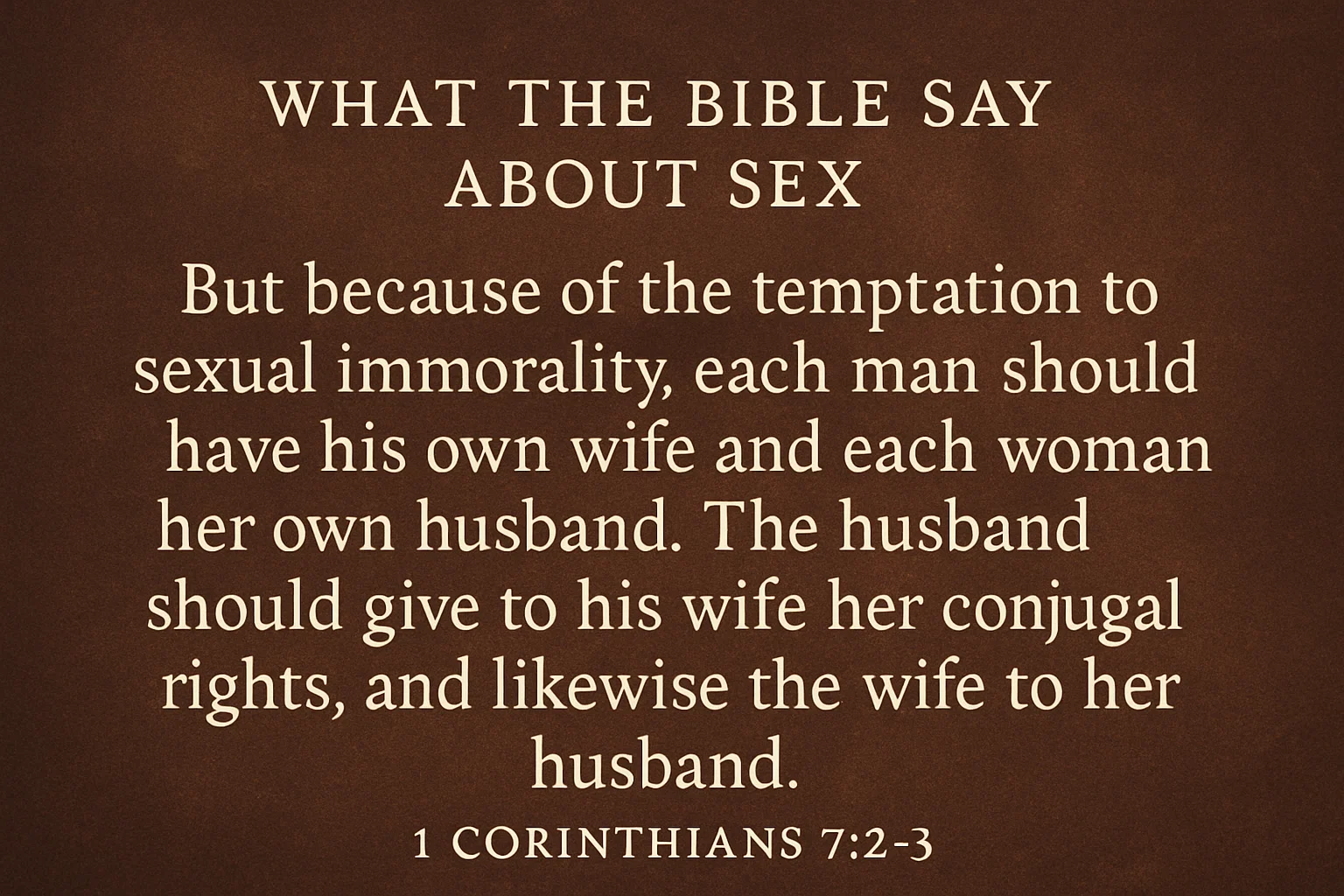
Paul’s words in 1 Corinthians 7:3-5 are powerful. He talks about marriage and sex as mutual giving. He tells couples not to deprive each other.
For many, this passage opens the door. It implies that any sexual act that is consensual, mutual, and loving is part of that “one flesh” bond.
What About the “Natural” Argument Again?
Still, some theologians take that “contrary to nature” argument from Romans and apply it here, too. They argue the body is “designed” one way, and any deviation, even in marriage, is unnatural.
The counter-argument is the same: “natural” probably meant “customary,” not “biological.” And if two married people are “one flesh,” then what they do in private is their “natural” expression of that bond.
How Do Different Christian Traditions View This Today?
All this debate means that, predictably, different churches have landed in completely different places. What your pastor says about this depends entirely on which tradition they come from.
What’s the Official Catholic Position?
The Catholic Church is the clearest. Based on its “natural law” tradition, any non-procreative sex act is “intrinsically disordered.”
That means it’s always morally wrong, even for a married couple. This isn’t from one verse, but from their whole theology of what sex is for. For more on this, the Berkley Center for Religion, Peace, and World Affairs at Georgetown University provides extensive resources on Catholic ethics.
How Do Conservative Protestant and Evangelical Churches See It?
Here, things get a bit more varied.
- For same-sex couples: It’s an almost universal “no.” They read Leviticus and Romans 1 as a clear condemnation.
- For heterosexual marriage: This is where it gets messy.
- One camp says it’s still sinful, period. Using the “unnatural” argument.
- Another large (and growing) camp calls it a “gray area.” It’s “Christian freedom.” It’s a private decision for the couple.
Are There More Progressive or Affirming Christian Views?
Oh, yeah. Many Mainline denominations (Episcopalians, Lutherans (ELCA), Presbyterians (USA)) are fully affirming.
They read those “clobber passages” as condemning exploitation (like pederasty and rape), not loving, faithful relationships.
In this view, the act itself isn’t “sinful” or “holy.” The context is what matters.
- Is it consensual?
- Is it mutual?
- Is it loving?
- Does it honor the other person?
If the answers are “yes,” then progressive Christians say the act is fine. Whether the couple is straight or gay.
Beyond Specific Verses, What Guiding Principles Does the Bible Offer?
When the rules are this fuzzy, a lot of people step back. They look at the “big picture” principles in the Bible to guide them.
The “Love Your Neighbor” Commandment (Mark 12:31)
Jesus said “Love your neighbor” was the second-biggest commandment. That’s a powerful ethic for sex.
Is the act an expression of love? Or is it coercive? Is it selfish? Is it degrading?
This puts all the focus on the quality of the relationship, not the plumbing.
What About “My Body is a Temple” (1 Corinthians 6:19-20)?
Paul’s “your body is a temple” line (1 Corinthians 6) gets used for everything. Tattoos, drinking, you name it. “Glorify God in your body.”
- One reading: “Glorify” means “keep pure.” Keep it clean from “unnatural” acts. And for some, that includes anal sex.
- Another reading: “Glorify” means “to honor.” It means treating your body, and your partner’s body, with incredible respect. In this view, the verse is a powerful argument against any act that harms, demeans, or coerces. It’s about mutual respect.
A Final Personal Reflection
I’ll be honest, as a guy, I was taught that sex was just a list of “don’ts.” A list of rules wrapped in fear.
But after years of looking at this, I’m convinced the Bible’s “big picture” is less about a list of forbidden acts and more about the quality of our relationships.
Is it loving? Respectful? Mutual? Is it really “one-flesh,” or is it selfish?
For me, those are the harder, and more important, questions.
So, What’s the “Final Answer”?
So, the final answer?
If you’ve read this far, you know there isn’t one.
I can’t give you a simple “The Bible says…” I really wish I could. But the text, the context, and the interpretations are all just… debated. Fiercely.
Why Can’t Scholars Just Agree?
Scholars can’t agree because they’re starting from different places. They have different ideas about the Bible’s authority, about tradition, about culture, and about the whole point of sex.
These are mostly smart, faithful people all trying to understand God’s word. They’re just asking different questions and using different tools.
What Does This Mean for My Own Faith?
This means your conclusion will depend on which big-picture idea you find most convincing.
- If you see the Bible as a clear rulebook, and “abomination” is a timeless word, your answer is “no.”
- If you see those laws as cultural, and the Bible’s silence on marriage as freedom, your answer for a married couple might be “yes, if it’s consensual.”
- If you believe the highest rule is love, and the “clobber passages” are about exploitation, your answer is “yes” in any loving, committed relationship.
This isn’t a shortcut to an easy answer. It’s an invitation to do the hard work. To study, to think, to examine your own conscience, and to prayerfully figure it out for yourself.
Moving from “Rules” to “Relationship”
Maybe the Bible’s final word on sex isn’t a rulebook. Maybe it’s a call to love, pleasure, and deep, holy intimacy.
The debate isn’t going away. Not because the Bible is irrelevant, but because faithful people are still wrestling with what that looks like, right here, right now.
FAQ – What Does The Bible Say About Anal Sex
Does the Bible mention anal sex directly?
No, the Bible does not explicitly mention anal sex. The discussion around it involves interpreting passages about sex in general, but there is no specific verse that addresses anal sex directly.
What is the story of Sodom and Gomorrah really about?
The story of Sodom and Gomorrah in Genesis 19 is often linked to homosexuality, but many scholars argue the primary sin was pride, inhospitality, and moral corruption, with the attempted gang rape being a symptom of a deeply rotten society.
Are the Levitical laws about homosexuality applicable today?
Many Christians see these laws as specific to the cultural and ritual context of ancient Israel, often about pagan fertility rites, and not binding in the same way today, especially since the early church decided not all Jewish laws apply to Christians.
What do the New Testament writings say about homosexuality?
The New Testament contains passages like Romans 1 and 1 Corinthians 6 that are often interpreted as condemning homosexual acts. However, scholars debate the meanings of Greek words like ‘arsenokoitai’ and whether they refer to exploitation, specific acts, or all same-sex relationships.
What is the best way to understand what the Bible says about sex today?
The Bible does not give simple rules about modern sexual practices; instead, it emphasizes love, mutual respect, and the intent behind actions. Different Christian traditions interpret these principles differently, making personal reflection and understanding context essential.