It’s one of the most personal questions a Christian couple can ask. It sits right at that messy intersection of faith, family, finances, and health. My wife and I wrestled with it. So have our friends. If you’re here, you’re probably in the same boat.
You go to your Bible. You look for that one clear chapter, that one verse.
And… nothing.
So, what does bible say about contraception? The honest truth is, the Bible doesn’t mention the pill, IUDs, or condoms. They didn’t exist. What we get instead are principles, stories, and teachings about marriage, sex, and family. We have to prayerfully navigate all that. This article is my attempt to explain those principles, show how different faithful Christians interpret them, and look at the key passages that shape the whole conversation.
More in Sexuality & Marriage Category
What Does The Bible Say About Anal Sex
What Does Bible Say About Living Together Before Marriage
Key Takeaways
- The Bible doesn’t give a direct ‘yes’ or ‘no’ on modern contraception. No single verse settles it.
- The big scriptural debates are about Genesis 1:28 (“Be fruitful and multiply”) and the story of Onan in Genesis 38.
- Churches are deeply divided. The Catholic Church teaches that intentionally separating sex from procreation goes against God’s design.
- Most Protestant churches say contraception is okay. They see it as a decision of responsible stewardship, wisdom, and personal conscience.
- It all comes down to the purpose of marriage and sex. Is it always about being open to kids, or can the ‘one flesh’ aspect be celebrated on its own?
- Almost everyone agrees: this is a decision for a husband and wife to make together, with a lot of prayer and study.
So, I Opened My Bible to “Contraception”… and Found Nothing. Now What?
This is the first hurdle. You can’t look it up in a concordance. That silence is deafening, isn’t it? It’s a big part of why there’s so much disagreement.
The biblical world was just… different. Child mortality was tragically high. Having a big family was a sign of blessing, a sign of security. The main concern was almost always infertility, not the other way around.
Since there’s no direct command, we have to look for the principles. What is God’s design for marriage? For sex? For children? This isn’t about finding a loophole. It’s about genuinely trying to find the “mind of Christ” on this.
It forces us to ask deeper questions. What’s the point of sex in marriage? Is ‘have kids’ a command for every couple, or a general blessing for humanity? When we plan our family size, are we ‘playing God’ or are we being ‘wise stewards’ of the resources He’s given us?
This whole process, applying timeless truths to modern life, is what the Christian faith is all about. It takes grace. It takes humility. And a lot of prayer.
Is “Be Fruitful and Multiply” a Command for Every Couple, Always?
This is ground zero. Genesis 1:28. Right after creating Adam and Eve, God blesses them: “Be fruitful and multiply and fill the earth and subdue it…” He says it again to Noah after the flood.
So, here’s the question: Is that a universal, binding command for every married couple, forever? Or was it a general blessing for humanity to get started?
One perspective says yes, this is the foundational purpose of marriage. ‘Filling the earth’ is the key. In this view, marriage and sex are intrinsically linked to procreation. That doesn’t mean every single act must make a child. But it does mean every act should, in principle, be open to life. To intentionally block that possibility, then, is to go against that first command.
But there’s another way to see it. This perspective views it as a ‘cultural mandate’ given at the dawn of creation. And, well, the earth is pretty full. This view argues the command was about establishing humanity, a mission that’s largely complete. Children are still an incredible blessing, but the New Testament shifts the focus. Look at Paul. He praises singleness for the sake of the kingdom (1 Corinthians 7). That right there proves procreation isn’t the only or highest calling. This view would say the ‘be fruitful’ passage shows kids are a good and natural result of marriage, not a mandatory quota.
Does this mean any family planning is wrong?
This is where it gets really personal, isn’t it?
I remember sitting on the couch in our pastor’s office for pre-marital counseling. My fiancée (now my wife) and I were in our early twenties, just starting careers, full of dreams. Our pastor, a kind man, asked, “What do you believe God’s purpose for your marriage is?”
We gave the classic ‘Sunday School’ answers. Companionship. Mutual support. A picture of Christ and the Church.
Then he pressed: “What about children?”
We admitted we wanted them. Someday. But we were also scared. We wanted to be “set” first. He challenged us. Was our desire to ‘wait’ rooted in wisdom, or was it rooted in fear? Were we trusting God, or were we trying to control every last detail?
That conversation didn’t give us a simple answer. But it did force us to confront our motives.
For a lot of Christians, the debate isn’t ‘planning’ vs. ‘no planning.’ Think about it. Even couples who only use Natural Family Planning are ‘planning.’ The real question is how and why we plan.
I’ve Heard the Story of Onan. Was He Struck Down for… Well, You Know?
If you’ve been in this discussion for five minutes, someone has brought up Onan. His story is in Genesis 38. It’s the only place in the Bible that explicitly describes a form of birth control (withdrawal) and links it to God’s judgment.
Here’s the story: Onan’s brother, Er, dies. According to Levirate law, Onan was required to marry his brother’s widow, Tamar. Their first-born son would be considered the heir of the dead brother, keeping the family line and inheritance intact.
But listen to what the Bible says: “But Onan knew that the offspring would not be his. So whenever he went in to his brother’s wife, he would spill his semen on the ground, so as not to give offspring to his brother” (Genesis 38:9). The next verse is chilling: “And what he did was wicked in the sight of the LORD, and he put him to death also.”
So, the billion-dollar question: What was wicked? Was it the act of ‘spilling his semen’? Or was it the motive behind the act?
Was Onan’s sin the method, or the motive?
This is the single most important interpretive split.
One view: The sin was the act itself. This is the view that’s foundational to the Roman Catholic position. It argues that the act was the sin. Onan deliberately engaged in sex while frustrating its natural, God-ordained purpose: procreation. He separated the unitive part (being ‘one flesh’) from the procreative part (the potential for life). The act was ‘unnatural.’ It violated the design of sex. Therefore, any act that deliberately ‘spills the seed’ or blocks procreation is sinful. This view draws a direct line from Onan to all contraception.
Another view: The sin was the selfish motive. This is where most Protestant scholars land. They argue the act was just the mechanism for a much deeper sin. Onan’s sin was a cold, calculated rebellion. He was using Tamar for sex while selfishly refusing to do his duty to his dead brother. He didn’t want to raise up an heir for Er because it would mess with his own inheritance. It was about greed. It was a profound lack of love. In this view, God struck him down not for the method, but for the hard-hearted, rebellious motive.
For most Protestants, then, Onan’s story isn’t a blanket ‘no’ to birth control. It’s a powerful warning to check our hearts. Are our choices rooted in selfishness? Or in responsible, loving stewardship?
Why Do My Catholic and Protestant Friends Have Such Different Answers on This?
The Onan story is a good lead-in to the biggest modern divide. If you’re getting different counsel from different churches, you’re not crazy. This is one of the most significant points of disagreement between Catholic and Protestant theology.
The Catholic Church’s Stance: What is “Humanae Vitae”?
The Roman Catholic Church holds a clear and consistent teaching: all forms of artificial contraception are contrary to God’s law. This position was most famously outlined in the 1968 encyclical Humanae Vitae (Of Human Life) by Pope Paul VI.
The teaching isn’t just based on Onan or Genesis 1:28. It’s rooted in a deep theological framework about the nature of the marital act. The Church teaches that sex has two “ends.” There’s the unitive end (the love-giving and bonding of the spouses) and the procreative end (the life-giving and openness to children). The core of the teaching is that these two ends are inseparable. God willed them to be so.
Therefore, any act that intentionally separates these two ends is disordered. Artificial contraception (the pill, condoms, IUDs) is seen as a deliberate rejection of the procreative aspect. It is, in effect, saying “no” to God’s potential gift of life. In this view, a couple must be open to life in every sexual act.
This does not mean the Church commands couples to have as many children as physically possible. It does allow for family planning, but only through methods that work with the body’s natural cycles. This is known as Natural Family Planning (NFP). The Church sees NFP as different because the couple isn’t introducing an artificial barrier. They are simply choosing to act during a time they know to be naturally infertile.
The Protestant View: A Shift in Thinking?
For the first 1,500 years of church history, pretty much all of Christianity (including the Protestant Reformers) held a view similar to the one the Catholic Church holds now. They saw the primary purpose of sex as procreation and generally condemned contraception.
The major shift happened in 1930. At the Lambeth Conference, the Anglican Church broke with this historic tradition and determined that, in certain cases, contraception could be permissible. That decision opened the door. Over the 20th century, nearly all mainline and evangelical Protestant denominations came to a similar conclusion.
So, why the change? It really boils down to a few key principles.
First, Sola Scriptura (Scripture Alone). Protestants look for a direct command in the Bible. Since the Bible doesn’t explicitly forbid contraception, they argue it can’t be mandated as a sin for all time.
Second, there’s that ‘motive over method’ view of Onan. The focus shifted to the why.
Third, Protestants place a high value on the unitive, bonding aspect of sex all by itself. Passages like the Song of Solomon celebrate marital love and pleasure with no mention of children. Sex is a gift to bond the couple, in addition to being how we have kids. From this angle, it’s not sinful to celebrate that bonding gift on its own sometimes.
Finally, it comes down to conscience and Christian liberty. In areas where Scripture is silent (what some call adiaphora, or ‘things indifferent’), the decision is left to the prayerful, educated conscience of the husband and wife.
And that’s why, in most evangelical and mainline Protestant churches, you’ll find contraception is widely accepted as a matter of wisdom and stewardship.
What about Eastern Orthodoxy?
The Eastern Orthodox Church’s position is much closer to the Catholic view than the Protestant one. They also hold to the historic Christian teaching that views contraception as a frustration of the primary purpose of marriage. However, the Orthodox tradition often allows for more pastoral flexibility, a concept known as oikonomia (economy). An Orthodox Christian may be permitted to use non-abortifacient contraception for a time after prayerful consultation and with the blessing of their spiritual father (priest), especially in cases involving health or other serious concerns. The ideal remains to be open to life, but pastoral care may allow for exceptions.
Okay, the Old Testament is Complicated. What Does the New Testament Add?
The New Testament adds another layer. It brings in our bodies, our relationships, our motivations. It shifts the whole conversation from legal commands to the heart and to mutual love.
Is My Body Really My Own? (1 Corinthians 7)
This chapter is probably the most significant New Testament text on the subject. Paul is addressing questions from the Corinthian church about marriage and sex. He writes:
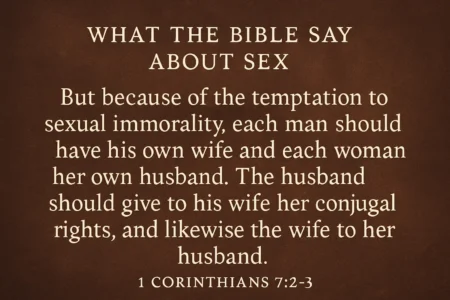
“The husband should give to his wife her conjugal rights, and likewise the wife to her husband. For the wife does not have authority over her own body, but the husband does. Likewise the husband does not have authority over his own body, but the wife does. Do not deprive one another, except perhaps by agreement for a limited time, that you may devote yourselves to prayer; but then come together again, so that Satan may not tempt you because of your lack of self-control.” (1 Corinthians 7:3-5)
This passage is revolutionary. It establishes that sexual intimacy is not just for one person’s pleasure or purpose. It’s a mutual gift. It’s a right and duty within marriage. This mutual “authority” means that decisions about sex—and by extension, the consequences of sex (children)—are not to be made unilaterally. A husband cannot just demand children from his wife. A wife cannot unilaterally decide to avoid intimacy (or pregnancy) without her husband.
This passage demands spousal unity. Whatever decision a couple makes about contraception, it must be a decision they “agree” on. It also places a high value on the regularity of sexual intimacy as a good thing in itself, a protection against temptation and a source of unity.
Your Body is a Temple
Another key New Testament principle is found in 1 Corinthians 6:19-20: “Or do you not know that your body is a temple of the Holy Spirit within you, whom you have from God? You are not your own, for you were bought with a price. So glorify God in your body.”
This verse is used by both sides of the debate.
On one hand, some argue that “glorifying God in your body” means respecting its natural design. This view would be cautious about introducing powerful synthetic hormones (like the pill) or devices (like IUDs) into the body. They might see them as an “unnatural” interference with the “temple.”
On the other hand, some argue “glorifying God in your body” means being a good steward of it. If another pregnancy would seriously endanger a woman’s physical or mental health, then using contraception to protect her “temple” would be a wise and godly act. If a couple is so emotionally and financially drained that they cannot properly care for their own bodies (or the children they have), stewarding their health may involve contraception.
If the Bible is Silent on the “How,” Does It Say Anything About the “Why”?
This is where the rubber meets the road for most Protestant Christians. If the method isn’t the main issue, the motive is everything. And this is where we have to be brutally honest with ourselves.
Are We “Playing God” or “Practicing Stewardship”?
That’s the central tension, isn’t it? Is planning your family an act of faithful stewardship, or is it an act of fearful control?
The argument for stewardship goes like this: God gave us wisdom. He gave us medicine and resources. He expects us to use them. We plan our finances. We plan our careers. We plan our meals. Why would family size be the one area of life that’s totally exempt from wise, prayerful planning? God tells us to ‘count the cost’ (Luke 14:28). A couple can prayerfully ‘count the cost’ of another child—emotionally, financially, physically. They might decide the wisest, most loving thing for the kids they already have is to wait.
I have to be honest. When my wife and I had our first child, I was completely overwhelmed. I loved him more than life itself. But the lack of sleep. The financial pressure. The sheer weight of it all… it was more than I bargained for. I felt like I was failing.
I remember one night, standing over his crib, my wife came up behind me. I just confessed my fear. “How can we even think about another one right now? I feel like I’m failing him.”
It wasn’t a lack of faith in God. It was a moment of real-world stewardship. We had to ask if bringing another child into that stress, right then, was the wisest thing. That conversation forced us out of abstract theology and into very concrete prayer. We weren’t trying to ‘play God.’ We were trying to be faithful stewards of the little family He’d given us.
The counter-argument, of course, is that this ‘stewardship’ is often just fear and selfishness dressed up in nice clothes. This perspective champions a radical trust in God. It believes He’ll provide for every child He sends (Matthew 6:26). It’s a powerful challenge. Are we delaying kids to buy a bigger house, or advance a career, or just keep life comfortable? If the motive is selfish, then using contraception to get there would be sinful.
What’s the Difference Between “Contraception” and “Abortion”?
This is a critical, and often misunderstood, part of the conversation. For all Christians who believe life begins at conception (fertilization), there’s a bright, uncrossable line. Abortion, terminating an established pregnancy, is taking a human life.
But the lines get blurry when we talk about how different ‘contraceptives’ work. Let’s break it down:
- Barrier Methods (Condoms, Diaphragms): These methods prevent fertilization from ever happening. The sperm and egg never meet. For most Christians, these are in a completely different ethical category from abortion.
- Hormonal Methods (Most Birth Control Pills, the Patch, the Ring): These primarily work by preventing ovulation (the release of an egg). If there is no egg, there can be no fertilization. They also thicken cervical mucus as a secondary mechanism, blocking sperm. These are also widely considered contraceptive, not abortifacient.
- Potential Abortifacients (IUDs, Morning-After Pill): This is where the debate becomes most intense. Some methods, like the copper IUD, primarily work by creating an inflammatory response that is toxic to sperm and eggs (preventing fertilization). However, it is also believed they may, in some cases, work by preventing a fertilized egg (a new, unique human life) from implanting in the uterine wall. The same concern is raised about the morning-after pill (Plan B) and some hormonal IUDs.
Because of this possibility, many pro-life Christians who are perfectly comfortable with condoms or the pill will not use an IUD or the morning-after pill. They believe the risk of it causing the destruction of a fertilized embryo is too high. This is a crucial distinction that every couple must research and consider.
My Spouse and I Don’t See Eye-to-Eye on This. What Now?
This is a painful and difficult place to be. But the Bible isn’t silent here. That command in 1 Corinthians 7 to “not deprive one another, except perhaps by agreement” is your guide.
This decision must be made in unity.
One spouse can’t just override the other’s conscience. If one of you believes it’s a sin and the other doesn’t, forcing the issue either way will create a deep wound. This is the hard work of marriage. It means long conversations. It means listening more than talking. It means both of you humbly going back to the Bible and praying, “God, show us the way. Make us of one mind.”
Unity is the immediate, non-negotiable command. The ‘right’ answer on contraception is the wisdom you have to find together. For couples in this spot, resources from groups that bridge faith and medicine can be a huge help. The Christian Medical & Dental Associations (CMDA), for example, has articles on these topics from a faith-based medical perspective.
So, How Do We Make This Decision?
If you are a Protestant Christian couple, and you believe this is a matter of wisdom and conscience, how do you move forward? Here is a practical framework:
- Pray Together. Don’t skip this. Ask God for wisdom, clarity, and unity. James 1:5 is a promise: “If any of you lacks wisdom, let him ask God… and it will be given him.”
- Study Together. Read the passages from this article out loud. (Genesis 1, Genesis 38, 1 Corinthians 7). Talk about what you both see.
- Seek Wise Counsel. Talk to your pastor. Talk to an elder or a mature Christian couple you trust. Don’t ask them for the answer. Ask them to pray with you and share their wisdom.
- Research the Methods. Seriously. Understand how they work. Are you comfortable with the mechanism? What are the health risks for the wife?
- Honestly Examine Your Motives. This is the hardest part. Get a piece of paper. Write down why you want to use contraception. Are those reasons about fear and selfishness? Or wisdom, love, and stewardship? Be honest. God already knows the answer.
Where Does This Leave Us?
As you can see, there’s no simple, one-verse answer. The Bible doesn’t hand us a memo. It gives us a beautiful, complex, and profound theology of marriage, sex, kids, and stewardship.
For some, the answer is clear. The Catholic teaching on the inseparable nature of sex and procreation means artificial contraception is never the right path.
For others, the answer is found in Christian liberty. This is the Protestant view: since the Bible is silent, the decision is left to the prayerful, unified conscience of the husband and wife. Here, the focus is all on the motive—making sure the ‘why’ is rooted in wisdom, not selfishness.
This isn’t a ‘right’ vs. ‘wrong’ issue for many of us. It’s a ‘wisdom’ issue. It’s a journey of walking together, in prayer, seeking to honor God with our bodies, our marriages, and our families. Whatever decision you and your spouse land on, may it be one that brings you closer to each other and closer to Him.
FAQ – What Does Bible Say About Contraception
How does the story of Onan relate to contraception?
Onan’s story is often cited in discussions, but interpretations vary. Some see it as condemning the act of spilling seed, equating it with contraception. Others believe Onan’s sin was selfishness or rebellion, not the act itself, emphasizing motives over methods.
Why do Catholic and Protestant teachings differ on contraception?
Catholic teaching, based on documents like Humanae Vitae, sees artificial contraception as contrary to God’s design, emphasizing inseparability of sex’s purposes. Many Protestant churches, valuing individual conscience and the gift of marital bonding, accept contraception as a matter of wisdom and stewardship, especially when it aligns with natural law or personal motive.
How should couples approach family planning when they disagree?
The Bible emphasizes unity in marriage, so couples should seek prayer, study key scriptures, consult wise counsel, understand the methods, and honestly examine their motives, striving to make decisions together that honor their faith and relationship.
What does the Bible say about contraception?
The Bible does not explicitly mention modern contraception methods like the pill or IUDs. Instead, it offers principles, teachings, and stories about marriage, sex, and family, which require prayerful navigation to understand God’s will.
Is ‘Be fruitful and multiply’ a command for all couples today?
This verse in Genesis is debated; some see it as a universal command for every marriage, emphasizing openness to life, while others view it as a blessing for humanity’s growth, not an obligatory quota that requires rejection of family planning.